

 Next
Next


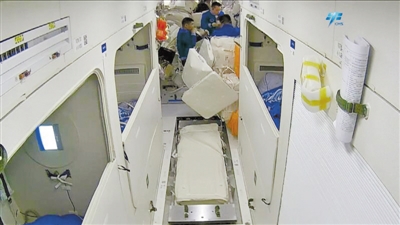 |
| The taikonauts on Tianhe core module no longer have to sleep standing up and can enjoy undisturbed deep rest in three seperate bedrooms. (PHOTO: VCG) |
The cabins of China's manned space station, the Shenzhou series of manned spacecraft, the Tianzhou series of cargo spacecraft, and the Long March launch series of carrier rockets were developed by China Aerospace Science and Technology Corporation (CASTC), as was Shenzhou-12.
Compared with previous flight missions, the Tianhe core module provides three times more space for astronauts in the Tiangong-2 Space Laboratory. According to the data collected from the full-sized model of the core module, Tianhe, the taikonauts' living area has a diameter of 3.35 meters. It is equipped with three separate bedrooms and one bathroom to facilitate their daily life routine. The three separate bedrooms mean an improvement in the taikonaut sleeping patterns as they no longer have to sleep standing up and can enjoy undisturbed deep rest.
In the field of aero-communication, through the set up of the space-to-earth communication link and video call equipment, a two-way video call between the space station and ground base can be achieved, sending and receiving emails.
Regarding manned environment control, compared with previous manned missions, the core cabin of the space station is equipped with a regenerative life support system, which includes subsystems such as electrolytic oxygen production, condensed water collection and treatment, urine treatment, carbon dioxide removal, and harmful gas removal. It can also recycle water and other consumable resources to ensure the long-term stay of taikonauts in orbit.
According to CASTC, the daily living space in the early Shenzhou-7 was only seven square meters. Tiangong-1 was upgraded to 15 square meters, which could accommodate the work and living space of three astronauts in orbit. In the current situations, the activity space in the core cabin of Tianhe has increased to 110 square meters.
The current space station has a living area and a working area. The living area has separate sleeping, ablution, exercise, kitchen, and dining sections. The design ensures that maximum consideration has been given to the privacy and convenience of taikonauts, as demonstrated by each having a handheld terminal, allowing them to adjust the cabin's lighting, sleep, work, and sports modes through the APP.
As for health issues after being upgraded, the taikonauts have a wrap around shower facility where the shower nozzle can be hand held for optimum personal hygiene.
Another major factor of wellbeing in modern life, whether on solid ground or in space, is access to a reliable WiFi network. The China Space Station has adopted brand-new technology in this regard and is equipped with mobile WiFi.