

 Next
Next


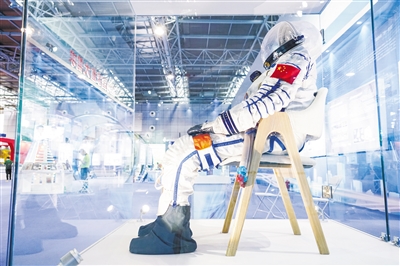 |
| A Chinese Space uniform was displayed to the public during the National Science and Technology Week in May in Beijing. (PHOTO:VCG) |
Three Chinese astronauts, arrived at China's space station aboard the Shenzhou-12 mission in mid-June. During the three-month stay, they will perform two extravehicular tasks (EVAs) involving assembly and installation. The two taikonauts' extravehicular activities are supported by China's new-generation spacesuit named Feitian.
Literally, Feitian means "flying to space." It is a reference to the apsara or "flying deva” in Chinese, and most famously depicted in Chinese art in the grottoes of Dunhuang. Spacesuits for EVAs, composed of garments, equipment and systems, are designed to defend taikonauts against the threats from the outer space, such as extreme low temperatures, radioactive rays and lack of oxygen, therefore ensuring absolutely safe working conditions in space and allowing them to carry out stipulated tasks.
One of the most significant advances in the new generation of Feitian extravehicular spacesuits is the extension of function time in outer space.
The spacewalk on July 4, 2021, conducted by the taikonauts also verified the long-duration life support system of the spacesuit, which has seen a great leap forward from the old generation of suits employed in the Shenzhou-7 mission. The new-generation suit can withstand temperature differences of more than 200 degrees Celsius, space radiation and other harsh environmental conditions and can allow the taikonauts to work a maximum of eight hours outside the spacecraft, up from four hours previously.
What’s more, Feitian is a one-size-fits-all spacesuit, with smaller and more flexible limb joints, able to fit a taikonaut with a height range between 160-180 centimeters. “It's more comfortable than before," said Shenzhou-12 taikonaut Liu Boming, who also participated in the Shenzhou-7 mission in 2008. As they have better mobility, the spacesuits can better protect the taikonauts and are easier to maintain, making it more convenient for them to perform space tasks.
Another point worth mentioning is that it only takes a taikonaut about five minutes to put on and take off the spacesuit as it weighs 130kgs, which is a big progress compared with the old one. When putting on "Feitian" spacesuit, the astronaut has to sit on the edge of the backbag called the primary life support, which contains the oxygen that astronauts breathe during a space walk. According to the deputy chief designer of the mission, Zhang Wanxin, all of the metal parts have been hollowed out through the method of typology, so as to reduce the weight, as a very small weight is significant in outer space. This development has paved the way for future space plans.
"There's some electronic equipment, such as cameras added to the suits, which are helpful for us to complete tasks," said Nie Haisheng. Indeed, by contrast to previous generation spacesuits, the new one features control consoles, video cameras and an audio system. The Feitian's helmets are equipped with cameras, broadcasting a first-person view similar to NASA's extravehicular activity unit (EMU) spacesuit.
The helmet’s bubble is composed of four layers: two are pressure resistant windows, the middle one is injected with nitrogen, which serves as an anti-fogging agent and has the function of heat insulation, the outer-most is the space window in case of clashes and scratches while conducting scheduled tasks.
When exiting the cabin and entering outer space, taikonauts will be confronted with harsh environmental conditions, but with the Chinese developed "Feitian" spacesuits and its multi-function ability almost making it a mini manned spacecraft, the safety and comfort outside the space station are ensured.