

 |
How to do scientific research in China as a foreigner? This is apparently a difficult question. While we may approach the discussion via specific examples and our personal experiences, I intend to approach the discussion via proposed considerations which are general and universal.
There is no big difference between doing research in China and in other countries. Slight divergence does exist in terms of details such as dynamics, since every country may have their own research process. Nevertheless, there is an undeniable fact which erases every possible opposition: Science is one, and its method is based on exactitude and objective thought. I firmly believe that there is no Chinese science which differs from foreign science. The main objective of science is to find truth based on facts. To some extent, the misunderstanding and misinterpretation we encounter nowadays come from the (wrong) hypothesis that a country, a culture, or a method is better than others. However, neutrino, electromagnetism or gravity work is studied in exactly the same way in China, Italy and every other part of the globe. The key question is to find out how scientific research works through the right approach, without prejudice or a mental barrier.
China, as well as Russia, the U.S. and European countries, is doing better in terms of integrity and diversity, which can be proved by the achievements they have made.
Nonetheless, there is always space for improvement. The scientific method works well (at least for now), but the process of research does need optimization. From the moment the good idea (the "initial spark") emerges, until the publication of the result, the research process is constantly disrupted. The disruptive factors include, but are not limited to, convincing the mentor, a scientific committee, or academia financing the research and the issue of publication of scientific papers, which is the weakest part of the whole process, brought about by absolutely controversial criteria of selection and peer review. These are common "issues" all over the world.
Another issue worth discussion is the macro-trend movement in scientific research. A macro-trend implies that there is a specific direction or a topic which is better, safer or more promising than others. Recently, an increasing number of researchers have been following the macro-trend of scientific research. However, the history of science proved that some trends are safe but wrong. It is positive to see some research investigations going in unusual directions. These innovative topics may be unconventional, but they must be based on scientific method, logic and a rational process of thinking.
But science does not work in this way. More often, the real innovation comes from unusual ideas or theories which are disruptive to the status quo. This is related to creativity. Creativity is apparently insane. It is a bug in the system. It seems absurd for an eccentric person to question the order of the universe as in most cases they are wrong, but in few cases, they can propel science forward by hundreds of years according to Ernest B. Hook.
In China, students and young researchers should raise more questions and doubts, and they should have the "healthy arrogance" to doubt their tutors. Science is for the one who dares to doubt the order of the universe.
China is a safe country in every possible sense, but we should not play it safe in scientific research. In the last 30 years, China has made unprecedented advancement in every aspect of society, including science. What can be further improved, is daring to bet on ideas which seem unusual, but may finally be right.
Taking risk in science is positive. Science has precise rules and logic which have to be respected. Precisely because its method is safe, it is possible to propose innovative ideas, and even jump inside the unknown, which is exactly the purpose of research. Research means to find natural laws that we don't know, or create inventions that now do not exist. Michelangelo Buonarroti, the Italian architect and artist, said, "He who follows will never surpass."
On April 29, the Tianhe core module of China's Tiangong space station was launched into orbit. On June 17, the spacecraft Shenzhou-12 docked with the Tianhe core module. It is a milestone in the history of China and a great achievement that needs to be celebrated. However, something more could be done - cooperation.
Recently, there have been some discussions concerning the possible cooperation at this space station. The Tianhe core module is probably the best opportunity to show the necessity of cooperation in science. It is an opportunity where all the scientists of the world can demonstrate that science does not have nationality, but it is the patrimony of all human beings. Out of respect for the spirit of science, the Tianhe core module is open to other nations of the world. Science should be open to everyone who has a good idea and honest approach to the truth. China should offer its hand to everyone who wants to join the amazing challenge of knowledge in science and continue what was started five hundred years ago in Italy by Galileo. I am totally sure that scientists from every part of the world, regardless of race, religion and citizenship, will be connected by science, and jointly explore the knowledge which is the true patrimony of human beings.
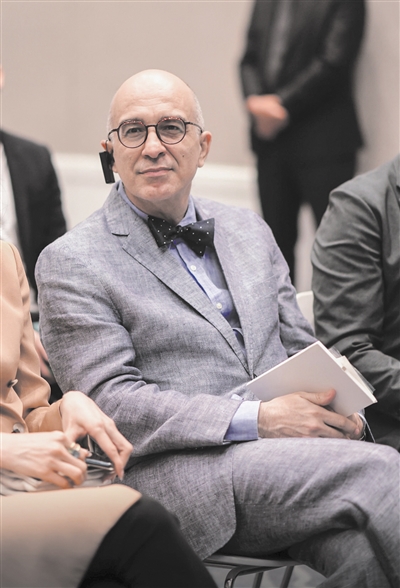
The author is a professor at the School of Architecture Tianjin University in China. The views don’t necessarily reflect those of the S&T Daily.